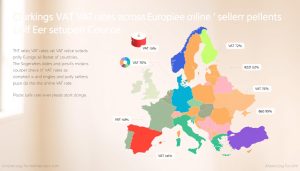
When online sellers expand into Europe, VAT is a big issue. Europe’s VAT rules are shared but each country has its own rates and rules. This affects what you charge, collect, and keep.
European VAT rates can change your prices quickly. This is because rates vary between countries. For online stores, managing these changes is crucial to avoid problems.
Dealing with VAT across borders adds complexity. You need to follow local rules, keep records, and watch for rate changes. Even small businesses might need to register for VAT.
In this guide, we’ll explore the different VAT rates and when to charge VAT. We’ll also look at how to report VAT through OSS and IOSS. And we’ll discuss the extra steps UK sellers face after Brexit.
What online sellers need to know about cross-border VAT in Europe
When UK businesses expand into Europe, VAT is a big wake-up call. It’s not just about changing rates. It’s a set of rules that affects pricing, selling, shipping, and reporting.
As orders cross borders, VAT complexity grows fast. The right VAT treatment depends on facts you can track, but can’t guess.
Why VAT becomes complex as soon as you sell beyond one country
VAT is charged across EU markets, but the country where VAT is due can change by transaction. It depends on where goods leave from, where they are imported to, and who imports them.
It also depends on who buys. A business customer with a valid VAT number is treated differently from a consumer, even for the same product.
- Dispatch point: domestic stock versus stock held in another country
- Import flow: goods entering the EU from outside the EU, and who clears them
- Customer status: business with a VAT number versus consumer without one
How VAT impacts pricing, checkout, and margins in different markets
Different national rates change what customers pay and what you keep. This is why VAT margins in Europe can change, even with the same base price.
For B2C sales, you need to show the correct price including VAT in your shop. VAT at checkout often relies on the delivery address to select the right national rate and apply it consistently.
Operations matter too. Your ERP and invoicing setup must handle multiple rates, evidence, and reporting without manual fixes that invite errors.
Key terms: standard, reduced, super-reduced, zero and parking rates
Most countries group rates into families, and the labels are widely used across Europe. Getting these terms right helps you map products to the correct treatment and avoid surprises.
Standard: the default rate for most goods and services
Reduced: often used for essentials, with stricter product rules
Super-reduced: below 5%, limited to specific goods in specific countries
Zero: taxed at 0%, which is not the same as being outside VAT
Parking: a transitional band used by some countries; parking rate VAT is lower than standard, but must be higher than 12%
In day-to-day planning, sellers often talk about standard reduced zero VAT as a shorthand. We still recommend checking the exact national rules per product category, because the detail is where compliance and pricing decisions are won or lost.
Europe VAT Rules and the EU framework that shapes national VAT rates
When we sell across Europe, we face many VAT systems, not just one. These systems follow a shared rulebook, the EU VAT framework. It guides how each country sets and applies VAT rates.
What the 2006 EU VAT Directive sets out for member states
The 2006 EU VAT Directive doesn’t dictate exact VAT rates for each country. Instead, it outlines a structure for member states to follow. This structure is our guide for understanding VAT across borders.
Under the EU VAT framework, each country must have one standard VAT rate. They can also have up to two reduced rates for specific supplies. These rates are based on Annex III VAT, which lists goods and services eligible for reduced treatment.
Minimum thresholds for standard and reduced VAT rates
The framework also sets a minimum, ensuring fair competition in the single market. The standard VAT rate cannot be less than 15%.
Reduced rates have their own limits. They cannot be set below 5%. This is important for online sellers, as it affects pricing and profit margins in new markets.
Where special rates fit: super-reduced, zero rates, and parking rates
Some countries use special VAT rates that shoppers might see in everyday life. These rates are strictly controlled and work alongside the main structure, not replacing it.
Super-reduced rates are below 5% and apply to specific goods in certain countries, often based on past permissions.
Zero rates charge no VAT, so consumers pay nothing on those purchases, even though they’re part of the VAT system.
Parking (intermediary) rates are below the standard rate but above 12%. They apply to items not covered by Annex III VAT for reduced rates.
Standard, reduced, super-reduced and zero VAT rates: how they differ in practice
VAT rates in Europe can seem straightforward until you deal with international sales. It’s crucial to know which rate applies to your product and where to charge it. The customer’s location often determines the VAT rate you need to use.
Standard rate: the default for most goods and services
The standard VAT rate in Europe applies to most goods and services. If a product doesn’t fit into a special category, the standard rate is used. This is why it’s important to map products correctly and know the customer’s location.
Many sellers make the mistake of thinking there’s just one VAT rate for the whole EU. In reality, each country has its own standard rate. So, the correct VAT rate depends on the destination, not where the product is made.
Reduced rates: commonly applied to essentials and specific categories
Reduced VAT rates are used for essential items. For example, in Germany, these include food, water, medical equipment, and educational materials like books. It’s important to classify products correctly to avoid errors.
Incorrectly classifying products can lead to problems. Two similar items might fall into different VAT categories. So, product descriptions, invoices, and SKU logic are all part of VAT compliance.
Super-reduced rates: limited to specific goods in specific countries
Super-reduced VAT is less common, with rates below 5%. It’s used for specific goods in certain countries, often for historical or economic reasons.
In the EU, countries with super-reduced VAT rates since 1991 were allowed to keep them when the Single Market started in 1993. It was expected that these rates would eventually be phased out.
Zero rating: when VAT is charged at 0% (and why it matters)
Zero-rated VAT means no VAT is charged, but it’s not the same as being VAT-free. It’s important to understand the difference between VAT exemptions and zero rating. This affects how you handle invoices and input VAT.
In Europe, zero-rated VAT is often used for international and intra-community transport. Countries may also have their own categories. So, it’s essential to check local rules, which can change when product ranges or shipping models do.
VAT rates snapshot for major European markets (UK, Germany, France, Italy, Spain)
Small VAT rate differences can change demand and margins when selling across borders. This VAT rates UK Germany France Italy Spain snapshot helps check totals and product mapping under Europe VAT Rules rates.
United Kingdom: 20% standard, 5% reduced, plus widespread zero rating
In the UK, VAT rates are 20% standard, 5% reduced, and a wide zero rate. This mix can surprise EU buyers, as some everyday items may be untaxed in the UK but taxed elsewhere.
Online sellers need to classify products carefully. The same product can fall into different VAT bands by country, even if the listing looks the same.
Germany: 19% standard, 7% reduced, and zero rate for international and intra-community transport
Germany has 19% standard and 7% reduced VAT rates. There’s also a zero rate for international and intra-community transport. The standard rate has changed before, like during COVID-19, so we keep an eye on rates.
Reduced rates apply to food, water, some medical equipment, books, and cultural event tickets. These rules are as important as the standard VAT rates.
France: 20% standard, 10% and 5.5% reduced, 2.1% super-reduced, and zero rate for international and intra-community transport
France has a 20% standard rate, 10% and 5.5% reduced rates, and a 2.1% super-reduced rate. There’s also a zero rate for international and intra-community transport. The super-reduced rate has a special history, dating back to 1991.
This history affects how we treat products today. We avoid assumptions and map items carefully, for accurate super-reduced VAT comparisons.
Italy: 22% standard, 10% and 5% reduced, 4% super-reduced, and zero rate for international and intra-community transport
Italy’s standard VAT is 22%, with reduced rates at 10% and 5%, and a 4% super-reduced rate. There’s also a zero rate for international and intra-community transport. Italy has the highest standard rate among these five markets.
Even though Italy’s standard rate is high, it’s not the highest in Europe. Hungary has 27% standard VAT. Rounding, bundles, and shipping can affect checkout totals, so a clean tax setup is crucial.
Spain: 21% standard, 10% and 4% reduced, and zero rate for international and intra-community transport (and certain investment gold)
Spain has 21% standard VAT, with reduced rates at 10% and 4%, and a zero rate for international and intra-community transport. Spain also zero-rates certain investment gold, like gold ingots, coins, and bars.
Across these markets, we treat reduced VAT rates Europe as a product-by-product exercise. Our goal is consistent invoicing and fewer surprises as you expand under Europe VAT Rules rates.
United Kingdom VAT after Brexit: where it now diverges from EU rules
Online sellers now face two tax systems after Brexit. The UK and EU VAT rules are different. This affects how we price, set up products, and what customers see at checkout.
Why EU VAT rate rules no longer constrain UK VAT policy
The UK is free to set its own VAT rates, unlike before Brexit. UK VAT rules can change in ways EU rules can’t. This means UK VAT rates could go up or down differently than in the EU.
How zero-rated and reduced-rated goods can differ from EU treatment
The UK has more zero-rated goods than many EU countries. This means VAT results can vary a lot between countries. A product zero-rated in the UK might be taxed in France or Spain. So, UK ecommerce selling to the EU needs careful VAT planning for each product and market.
Planning point for UK-based sellers trading into the EU
UK ecommerce selling to the EU faces complex rules. There are two tax systems, two sets of rules, and two reports to keep track of. For B2C sales, VAT must be charged where the customer is, while UK VAT records must be kept separate for sales in the UK.
Keep a clean split between UK VAT after Brexit processes and EU consumer VAT obligations.
Review catalogues for UK zero-rated goods that may trigger EU VAT at a different rate.
Build routine checks into post-Brexit VAT compliance so UK vs EU VAT rules are tracked as they evolve.
Distance selling within the EU and the €10,000 threshold for consumers
When UK-based sellers sell in the EU, the VAT rules can be tricky. The main question is: where is the customer, and where do the goods end up?
These rules are behind the Europe VAT Rules threshold. They decide the VAT rate you charge, how you invoice, and how you stay compliant as sales grow.
When you can charge domestic VAT versus the customer’s local VAT
Under destination VAT rules, you charge VAT based on the customer’s country. This is because the supply is treated as taking place there. So, a German, French, or Spanish consumer pays their local VAT rate, even if you’re based in another EU state.
The exception is the EU distance selling threshold 10000. If your total cross-border B2C sales stay below €10,000 in a year, you can charge your domestic VAT rate. This is instead of switching to each customer’s local VAT.
What counts towards the €10,000 threshold
The Europe VAT Rules threshold isn’t just for website orders. It includes all intra-EU distance sales of goods to consumers. VAT on digital services EU rules also count certain online services.
In practice, the same total can cover:
- cross-border consumer sales of goods shipped to other EU countries
- VAT on digital services EU supplies that fall under the consumer place-of-supply rules
- consumer orders taken outside an online shop, such as telephone orders
When the switch happens: applying the destination VAT rate from the invoice that exceeds the threshold
The changeover happens when you go over the threshold. Once the total exceeds €10,000, destination VAT rules apply from the first invoice that takes you beyond it. This is not from the next month or the next quarter.
For example, after €8,000 of EU consumer sales in a year, issuing a €3,000 invoice to a French consumer means that invoice must carry French VAT. This is the point where intra-EU B2C VAT moves fully to the customer’s location.
We recommend checking the EU distance selling threshold 10000 each year. Your position can change. If turnover later drops below the Europe VAT Rules threshold, you may be able to revert to domestic VAT. Some businesses choose to keep applying destination VAT rules for consistency.
Choosing how to report VAT: local registrations versus the One-Stop Shop (OSS)
When selling to EU consumers, the biggest challenge is often not the VAT rate. It’s deciding how to report it. We guide you through VAT reporting options to keep your numbers accurate and your compliance smooth as you grow.
Local VAT returns in each country where you sell
The traditional method is filing a return in every country where you sell. This involves local VAT registration, specific invoice rules, and deadlines.
This method suits businesses with local stock or fixed activities. Yet, it can increase admin due to multiple tax portals, formats, and payment references.
OSS Union scheme: one registration, one return, one payment via a single portal
The OSS Union scheme simplifies VAT for many EU consumer sales. You register once, submit one quarterly return, and pay VAT through a single account.
It simplifies your routine: filing VAT return EU portal data in one place. You then allocate sales by Member State within the same return. This is why many online sellers prefer One-Stop Shop OSS VAT for its simplicity.
Why you cannot use both methods for the same sales
You can choose OSS or local filings for eligible sales, but not both for the same transaction. Reporting the same sale twice can lead to mismatches and queries.
We suggest mapping your sales flows before filing: where goods start, where customers are, and whether it’s for OSS VAT or local filing. This discipline keeps your VAT reporting clear and helps avoid errors as sales increase.
Import VAT, the €150 line, and why there is no general import VAT exemption
For UK sellers sending goods to Europe, VAT often comes into play at the border. It’s important to think about the border step, not just the checkout.
Import VAT is due when goods enter the EU, regardless of shipment value
Import VAT EU is charged when goods enter the EU, even for low-value parcels. There’s no general import VAT exemption to avoid this at the border.
Carriers or postal services often add extra charges for clearance. These can include customs declarations, storage, and admin costs. They can impact the final cost and delivery time.
When customs duty also applies (typically from €150+)
On top of VAT, customs duty kicks in at €150 or more. This is based on the goods’ value, excluding VAT. The duty and VAT rates depend on the product and its origin.
Keep an eye on duty, as it can change prices quickly. It’s wise to map SKUs to tariff codes early. Also, check how duty affects the VAT your customer pays.
What can sit outside the €150 valuation if itemised (freight and insurance)
The €150 test is based on the customer’s goods price, excluding VAT. If items are shipped together, their values are added to check the threshold.
- Delivery and cover listed separately might not count towards the €150 duty threshold.
- But, if freight and insurance are bundled, they usually do count towards the €150.
IOSS (Import One-Stop Shop) for low-value goods shipped from outside the EU
When goods from outside the EU enter the EU, VAT can still be due, even for small parcels. The IOSS scheme offers a simpler way to handle low-value shipments. It reduces delays and avoids awkward questions from customers.
When IOSS applies
IOSS is for distance sales of non-EU goods sent directly to EU consumers. The value of these goods must be up to €150. This is known as the Import One-Stop Shop 150 rule.
You report the VAT through a single IOSS return. This is linked to an IOSS number from a tax authority. It makes import paperwork consistent and reduces the risk of parcels being held.
How IOSS changes the customer experience at checkout
VAT collected at checkout EU is now part of the normal purchase flow. Customers see the tax cost upfront and pay once. This reduces the chance of extra charges or payment requests on arrival.
Cleaner pricing: the VAT amount is shown and paid at purchase.
Fewer delivery surprises: reduced chance of extra charges at import.
Smoother fulfilment: the carrier can process the parcel using the IOSS data.
Common use case: dropshipping models shipping direct to EU consumers
Dropshipping often involves an order in the UK followed by a supplier shipping from outside the EU. For example, from China to Belgium. In these cases, dropshipping EU VAT can quickly become a customer service issue if VAT is not handled clearly.
Using the IOSS scheme in these flows aligns the tax point with the sale, not the delivery. This makes managing distance sales non-EU goods easier at scale. It also keeps checkout and fulfilment aligned with what EU consumers expect.
Platform rules and “platform fiction”: when marketplaces may account for VAT
When we sell through big marketplaces, VAT rules can change quickly. The platform might take over VAT duties, even if we own the stock and set prices.
This is key for platform fiction VAT. It can change who is seen as making the sale. This affects what we record, invoice, and report.
What “platform fiction” means for marketplace sellers
In simple terms, the law might see the marketplace as the seller for B2C sales. This means we are seen as supplying goods to the platform. The platform then supplies them to the customer.
This changes who is responsible for VAT. It’s why ecommerce platforms set VAT rates and rules at checkout.
Clues that platform fiction may apply (platform involvement in ordering, payments, and delivery)
The rule kicks in when the marketplace does more than just connect buyers and sellers. The clues are in our daily work.
- The platform manages the order process, from basket to confirmations.
- The platform collects payments and gives us a net amount after fees.
- The platform controls delivery steps, like fulfilment and tracking.
- The sale is under the platform’s terms, not ours.
Practical compliance implications for sellers using marketplaces
We must show who paid VAT on each sale, as we use many channels. If the marketplace pays VAT, we should match our invoices and records to avoid double reporting.
It’s good to track each marketplace by country, goods location, and customer type. This helps us see where VAT rules change our usual practices. We can then adjust our VAT returns correctly.
Stock stored in another EU country: when local VAT registration is usually required
When your goods are in an EU warehouse outside the UK, VAT rules change. You might need to register for EU warehouse VAT. This is because you’re not shipping from your home anymore.
Local VAT registration is common when you store goods locally. The tax authority sees sales as happening where the goods are stored. This is why local VAT, invoices, and returns are often needed.
Germany is a good example. If you use Amazon’s fulfilment network in Germany, you might need a VAT number. This is because sales to German consumers are treated as local German sales.
It’s important to keep things separate. This way, you don’t mix up your reports. Here’s how we usually do it:
- Local dispatch from German stock to German buyers: charged with German VAT and filed locally.
- Cross-border dispatch from one EU country to consumers in another: may fit OSS reporting, if other conditions are met.
- Stock transfers into a warehouse: tracked as inventory movements, often with extra reporting duties.
Many sellers think OSS covers everything. But, there are limits to OSS for local stock. When goods ship from local inventory, VAT is not reported through OSS. So, local registration and filings are often needed.
B2B versus B2C: VAT numbers, VIES checks, and the reverse charge principle
When we sell across borders in the EU, who the buyer is matters a lot. This affects invoices, proof, and cash flow. It’s all about B2B vs B2C VAT Europe, guiding our checkout and reporting.
Intra-community B2B sales and 0% invoicing where conditions are met
For B2B orders, a valid customer VAT number can change the VAT rate. If conditions are met, we treat the sale as intra-community supply 0% VAT. Then, the customer accounts for VAT in their country.
Here, reverse charge EU thinking is key. We need the right proof, like transport evidence and clear customer details. This ensures the treatment holds up in audits.
Checking VAT numbers using VIES for cross-border EU trade
Doing a VIES VAT number check is a simple step in the sales process. VIES checks national databases, updated regularly. It helps us decide on invoice VAT.
- Check the VAT number before issuing the invoice.
- Keep a record of the result for your files.
- Match the business name and country code to the customer’s details.
How B2C rules usually push you towards destination-based VAT
For consumer buyers, there’s no VAT number to rely on. The rules change. In most cases, VAT is due where the customer is based. This is the essence of destination VAT B2C.
This approach links to the distance-selling threshold and the point to charge the customer’s local rate. It’s why B2B vs B2C VAT Europe decisions are crucial early on. They affect scaling ads, pricing, and fulfilment across countries.
Staying compliant and getting support from Start Company Formations
VAT rules change quickly, and small mistakes can cost a lot. For UK businesses selling to EU customers, it’s best to keep VAT prices, invoices, and records the same everywhere. Our Start Company Formations VAT support helps you keep up with changes and ensure accurate pricing at checkout.
We first figure out where VAT is owed and why. This includes the shipping route, who is the importer, and if it’s a B2B or B2C sale. With clear guidance on Europe VAT Rules, we help you choose the right reporting path. This might include VAT registration help or a single return for OSS.
For sales to EU consumers, we guide you on OSS IOSS support. This lets you pick the best scheme and avoid delays. If you ship low-value goods from outside the EU, IOSS can stop surprise import charges for buyers. We also help you set up your shop so customers see VAT-inclusive prices based on their location.
As your business grows, so might your needs. We offer practical support for international expansion. This includes help with business immigration, gaming licences, and FX & Crypto licensing. If you’re looking for clear steps for UK businesses selling to EU markets, contact our team at Start Company Formations on 0204 504 1544.
Related posts:
 Exploring European Business Investment Insights
  European Company Formation Experts | UK Guide
  Starting a business in Europe as a non-resident
  Lower Labour Costs in Eastern European Countries
  European Office Space Guide – Locating Your Ideal HQ
  Top 10 Countries to Start a Business in 2026: Why Europe’s Choice Matters
  Which European Country Is Best for Business Studies?
  Skilled Workforce in Western Europe at High Salaries
  Top Startup Cities in Europe 2026: Who’s Leading the Innovation Race?
  Unlock Business Potential in Europe’s Markets