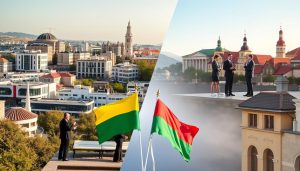
For UK entrepreneurs looking to expand to Bosnia, it’s a smart move. It lets you tap into Southeast Europe without breaking the bank. Bosnia and Herzegovina is a unique blend of East and West. Places like Sarajevo and Mostar show off a rich mix of cultures.
The economy of Bosnia and Herzegovina is growing. It’s an upper middle-income country with a GDP of about $28.3bn in 2024. With a per-capita GDP of $8,950, it’s a great place for businesses looking for value and growth.
Entering the Bosnia market can also benefit from its EU ambitions. Bosnia became an EU candidate in 2022. It has been working on reforms since 2016 to align with EU standards.
We make sure you know what to expect from the start. Setting up a company in Bosnia and Herzegovina involves understanding its complex system. The country is divided into the Federation of Bosnia and Herzegovina, Republika Srpska, and the Brčko District. The Federation is further split into ten cantons.
This structure can lead to duplicated rules and slower processes. We help you navigate through incorporation, tax registration, and setting up operations. If you need to relocate, we work with Immigration advisers to ensure everything is in order.
Strong Economic Growth
When we look at market entry, we focus on cashflow and demand planning. Bosnia’s GDP growth is steady, with 2.5% in 2024 and 2.7% in 2025 expected. This makes it a stable choice for UK founders.
We also check the basics for pricing and sourcing. Bosnia’s economy is around $26bn to $28.3bn in 2024, with a 2025 projection of $29.86bn. The Bosnian Convertible Mark (KM) is pegged at €1 = KM 1.958, which is important for daily planning.
Overview of Economic Indicators
Trade flows are key indicators we watch. In 2024, imports were $15.9bn, while exports were $8.9bn. This means Bosnia buys almost twice as much as it sells. Remittances from a diaspora of 2 million people help balance this.
Real growth: 2%–3% range in many estimates, with 2.5% widely cited for 2024
Currency stability: KM peg to the euro supports clearer forecasting
External balance: imports exceed exports, with remittances helping to bridge the gap
Key Growth Sectors
We identify key sectors for revenue mapping. The services sector makes up 60%+ of GDP, with tourism at about 20%. This is good for hospitality, transport, professional services, and IT outsourcing.
Manufacturing is another strong sector, making up 20% of GDP. It includes base metals, wood products, textiles, machinery, and automotive parts. Supply chains serve buyers like Volkswagen. Exports include metals, electricity, machinery, furniture, textiles, and agricultural products, with growth in hydro and wind renewables and agribusiness.
Strategic Geographical Location
For UK founders, Bosnia’s location is a bridge between EU supply chains and Balkan demand. It’s a smart base for fast market entry and manageable distances to capitals.
Access to European and Asian Markets
Bosnia sits at a Balkan crossroads, making it a trade hub for the region. It offers CEFTA and EFTA access, allowing for wider distribution while keeping operations near customers.
Trade frameworks expand its reach. Many firms use Bosnia Turkey free trade to tap into an 80 million consumer market. CEFTA and EFTA add another 50+ million consumers.
Transportation Infrastructure
Bosnia’s logistics are supported by 24,000 km of roads and 1,200 km of rail. Rail links to Croatia and Serbia, and close Adriatic ports, simplify freight planning.
Travel times are key. We can reach Vienna or Munich in about two hours by flight. International airports in Sarajevo, Mostar, and Banja Luka support regular business travel.
Competitive Operating Costs
For UK founders, keeping costs low often means managing monthly expenses. Bosnia’s operating costs are easier to predict. This helps when testing demand, hiring the first team, and keeping costs down.
The cost advantage isn’t just one bill. It’s the total of payroll, premises, utilities, and local services. All these work together to support a cost-effective expansion in Bosnia without sacrificing quality.
Low Labour Costs
Bosnia’s low labour costs are a big advantage. With a labour force of around 1.3 million people, finding the right staff is easier. This is thanks to a clear training and retention strategy.
The average salary in Bosnia is about €870 per month, compared to the EU’s €2,200. This difference is significant in roles like customer support and software delivery. It helps keep costs down as we grow.
More room to build shift coverage and service hours
Ability to invest in onboarding, tools, and QA without inflating payroll
Greater flexibility for pilot teams before wider rollout
Affordable Office Space
Having a stable base is important, and so is the cost of premises. Office space in Sarajevo is priced for early-stage teams. It offers a registered office, light fit-out, and reasonable monthly costs.
Aligning workspace strategy with hiring and delivery goals keeps costs in line with cashflow. This makes office space in Sarajevo a key part of a cost-effective expansion in Bosnia. It works alongside staffing plans based on Bosnia’s low labour costs and average salary.
Skilled Workforce
When we plan to grow, people are key. Bosnia’s workforce is skilled but less expensive than Western Europe. They are young, flexible, and ready to work globally.
Bosnia’s education levels are strong, making hiring reliable. About 35% of people have secondary or higher education. This helps build stable teams and supports specialist roles in technical and service sectors.
Education and Training
For export and industrial work, Bosnia’s engineering talent is a big plus. Manufacturers make parts for cars, machinery, and more. This fits well into global supply chains, as seen in partnerships with Volkswagen.
In heavy industry, ArcelorMittal in Zenica is a big player. It shapes supplier networks and boosts practical skills. This is crucial for roles like technicians, quality control, and production planning. It also helps with back-office tasks like procurement and compliance.
For digital work, IT professionals in Sarajevo are a great choice. They excel in software development, IT outsourcing, and more. Tech communities, like Sarajevo’s BIT Alliance, connect companies with local talent. This makes hiring easier as you grow.
Language Proficiencies
A multilingual workforce in Bosnia makes daily work smoother. It’s essential for handling sales, customer service, and product documents across borders. For UK founders working with EU partners, this can speed up approvals and reduce errors.
Clearer client communication across time zones and markets
Smoother handovers between technical, sales, and support teams
More consistent documentation for tenders, audits, and exports
Government Incentives for Investors
For UK founders thinking about Bosnia and Herzegovina, the right incentives can make a big difference. We look at Bosnia’s tax incentives that help with early cash flow, like building a team or importing equipment.
Tax Breaks
Bosnia has a corporate tax rate of 10%, one of the lowest in the region. This rate is great for setting up a subsidiary or an export hub. It helps with quicker reinvestment and better pricing.
There’s also a benefit for foreign investors. If you import equipment not made locally, you might get import duty exemptions. This can lower the cost of setting up manufacturing lines and upgrading equipment.
When you reinvest profits, your business can become more efficient. If you invest more than 50% of your profits in equipment, you could get a 30% tax cut. But, you must meet certain conditions and keep accurate records.
Grants and Funding Opportunities
Employment support is strongest when it shows clear job creation and a solid hiring plan. Hiring subsidies in Bosnia can help with first-year payroll costs. This is through programmes that offer co-financing.
Co-financing can cover up to 50% of new hires’ salaries in the first year, depending on the programme terms.
Applications work best when roles, start dates, and contracts match the business plan and budget.
This is ideal for UK-led service centres, export operations, and tech teams that grow in steps.
We see these incentives as connected levers. Match your staffing plan with co-financing and your equipment plan with import duty exemptions. With careful planning, Bosnia’s incentives can ease your first year.
Stable Business Environment
For UK founders thinking about starting a business in the Western Balkans, Bosnia offers a familiar environment. It values planning, clean records, and clear contracts. Bosnia has been a stable democracy since the 1990s.
Its long-term policy direction has been shaped by EU reforms since 2016. This has led to a clearer path for businesses.
Many firms appreciate the KM currency board peg to the euro. This makes budgeting easier by reducing exchange-rate swings.
Legal Framework
The legal framework in Bosnia is functional but complex. The country has two entities and ten cantons. This can affect permits and inspections.
We help clients by mapping out their obligations early. This keeps things clear and reduces the risk of corruption.
- Clear corporate governance, with traceable approvals and spending
- Consistent record-keeping for tax, employment, and licensing
- Local regulatory checks to confirm which level of authority applies
Political Stability
Bosnia’s political stability is steady, with some tension. The key question for investors is predictability. How reliable are processes and decisions?
EU reforms and regulatory alignment can make things more predictable. This is good for businesses looking to grow. It means clearer timelines and fewer surprises.
Emerging Technology Sector
The Bosnia tech sector is growing fast, not just for saving money. It’s attractive to UK founders for many reasons. They get EU-adjacent delivery, a familiar workday, and teams that grow without big costs.
Start-up Ecosystem
Sarajevo start-ups focus on real needs and quick action. Krompir.ba is a local digital service that meets everyday needs. It shows how to create value and keep things simple.
This approach works well in travel tech and event planning too. Seasonal tourism pushes for better booking and support tools.
As the market grows, groups like BIT Alliance help. They connect companies with talent and shared standards. This makes planning and moving to long-term projects easier.
Nearshore product teams for UK-based roadmaps
Service operations suited to BPO Bosnia models
Customer support and back-office workflows aligned to European time zones
Innovation in ICT
IT outsourcing in Bosnia is popular for software engineering and support. The ICT innovation here includes cloud tools and automation. This helps founders work faster and with less handovers.
When projects get bigger, structure is key. We help clients set up compliantly. This includes Gaming Licences and FX & Crypto Licensing, based on their plans and risks.
Rich Natural Resources
Bosnia’s natural resources are key for industries ready for export, attracting UK founders. The right mix of supply, skills, and demand is found in processing and power sectors.
Mining and Energy Resources
The Bosnia metals industry relies on a skilled workforce and a history in metal processing. It supplies steel and aluminium for machinery and components, targeting European markets.
Energy is also a strong sector. Bosnia’s hydropower generates 37% of its electricity, with 15 big plants running and 35 more planned. This creates jobs in generation, turbine supply, grid integration, and energy storage.
- Support for Drina river hydropower upgrades and new projects
- Industrial demand for Neretva river energy and network stability
- Opportunities in control systems, maintenance, and balance-of-plant equipment
Agriculture and Forestry
Besides minerals and energy, Bosnia has vast agricultural land and investable themes in agribusiness. There’s a need for organised livestock, organic farming, cold-chain logistics, and packaging that meets EU standards.
Forests also offer an export opportunity. Bosnia’s forestry wood processing supports the production of sawn timber, panels, and furniture. Quality and traceable sourcing are valued, aligning with UK and EU procurement standards.
Better Work-Life Balance
Founders and growing teams see lifestyle as a key to keeping staff. Living in Bosnia means routines that support focus, family, and planning. The pace is slower, yet days are packed.
Bosnia’s mix is perfect: busy Sarajevo streets and quiet hills and rivers nearby. Ottoman and Austro-Hungarian influences add depth to food, architecture, and public life. This makes downtime more enjoyable without the pressure to spend.
Safety is crucial when moving staff across borders. Bosnia is generally safe for everyday life, with caution advised as in any capital. While politics can cause tensions, daily life for locals and expats remains steady.
Quality of Life in Bosnia
Discussing Bosnia’s quality of life, we focus on what matters: neighbourhood feel, commute, nature access, and settling ease. Sarajevo and Mostar boast strong café cultures, walkable areas, and a social rhythm that supports balance.
Relocation also depends on essential services. Bosnia’s healthcare and education have improved, with public and private options. Sarajevo’s international schools make moving with children easier.
To ensure a smooth move, we collaborate with experienced Immigration advisers. They help align residency planning with company formation, banking, and hiring.
Cost of Living
Affordability is a big plus, ideal for early-stage scaling. Sarajevo’s cost of living is lower than many European capitals. This covers rent, groceries, transport, utilities, and everyday services.
- Lower monthly costs can extend runway and reduce salary pressure.
- Public transport is well used, and taxis are affordable for short trips.
- International airports and modern communications make regional travel and remote work easier.
For UK business owners considering mobility, Bosnia offers a great balance. It supports productivity and morale. Teams can live well while staying close to work.
Bi-lingual Business Practices
When we help UK-led firms set up in Bosnia, language is a key advantage. A bilingual workforce in Bosnia means clearer briefings and fewer misunderstandings. This speeds up operations across teams.
Language matters in everyday tasks, like onboarding staff and managing partners. In Bosnia, you can maintain high service standards while growing globally.
Language Skills in the Workforce
Having multilingual staff reduces delays in expansion. It ensures teams meet UK standards on tone and timing. This is crucial for service-based businesses.
- Customer support and client success for UK and EU users, including Bosnia outsourcing customer support
- Cross-border supplier communication with Croatia, Serbia, and wider EU networks
- Documentation workflows for incorporation, banking, tax, and contracting
Working with local teams and partners shows a business’s international maturity. Many use well-known brands like Microsoft and KPMG. This makes reporting and routines familiar.
English Proficiency
In Bosnia, English proficiency makes setting up easier for UK businesses. Meetings are quicker, and requirements clearer. This makes updates simpler to standardise.
This support is key in IT outsourcing, BPO, tourism, and export coordination. With a multilingual team in Bosnia, you can enter the market smoothly. Customer support outsourcing remains efficient and measurable against UK standards.
Growing Tourism Industry
Bosnia’s tourism is booming, and it’s a big deal. Tourism makes up about 20% of Bosnia and Herzegovina’s GDP. This means there’s a steady demand for places to stay, food, transport, and activities.
For UK founders, this is a great opportunity. Bosnia offers a European market with lots of potential and room for new businesses.
As more people visit, they’re looking for better experiences. This means there’s a chance for smart, well-run businesses to thrive. They can offer unique experiences and add-ons like tickets and event planning.
Opportunities in Hospitality
Investing in Bosnia’s hospitality means looking at different options. From guesthouses to boutique hotels, there’s something for everyone. Seasonal planning is key, whether it’s for city breaks or summer trips.
A strong tourism business in Sarajevo can also attract weekday visitors. This is thanks to conferences, cultural events, and corporate travel.
Modern businesses succeed by making things easy for guests. This is where travel tech in Bosnia comes in. It helps with booking, pricing, and communication, making things smoother for everyone.
- Mid-market accommodation with clean standards, reliable heating, and soundproofing
- Food and beverage concepts designed for repeat custom and tour groups
- Experience-led packages with transport, guides, and clear cancellation terms
- Operational support services, including housekeeping teams and maintenance scheduling
Cultural Attractions and Heritage
Bosnia’s heritage is a big draw, but it needs careful handling. Mostar’s Stari Most and old town are perfect for guided tours and small stays. Sarajevo’s mix of cultures keeps visitors engaged for longer.
Nature-based travel is also growing. Eco-tourism in Bosnia focuses on being sustainable. This includes waste management, local sourcing, and low-impact activities. Rural stays and outdoor adventures can make a brand stand out.
Favourable Trade Agreements
When we plan exports, distribution, or a new hub, trade access is key. CEFTA Bosnia and EFTA Bosnia help us see Bosnia as more than just a local market. They open up a wider sales route.
These agreements make it easier to reach big consumer markets nearby. They also cut down on border delays. The Bosnia Turkey free trade agreement adds more opportunities for businesses looking for steady demand and quick sales.
Bilateral Trade Relations
For UK-led plans, Bosnia EU trade is crucial. The EU is Bosnia’s biggest trading partner. In 2024, the EU bought $6.5bn (74%) of Bosnia’s exports and supplied $9.4bn (59%) of imports.
Looking at the next level of demand, CEFTA partners were important too. They bought $1.5bn (16%) of exports and supplied $1.9bn (12%) of imports in 2024. Bosnia has strong trade ties with countries like Croatia and Serbia.
- Route planning that matches existing freight lanes and buyer networks
- Distributor models built around repeat orders, not one-off shipments
- Pricing that reflects duty treatment, lead times, and documentation load
Membership in International Organisations
Bosnia is working towards better trade rules and easier market access. It became an EU candidate in 2022. Bosnia WTO membership is also a goal, showing its commitment to trade governance.
This means Bosnia is aiming for more standardised rules, clearer paperwork, and fewer surprises in cross-border trade. It makes it easier to set up internal controls early and grow with confidence as trade increases.
Potential for Networking and Partnerships
When we enter a new market, we look for people who already know the terrain. In Bosnia, this approach can cut early risk and speed up delivery. Bosnia business partnerships often start with a simple supplier fit, then grow into shared services or light processing for EU-facing output.
Bosnia’s export base still leans on raw materials and lower-value goods, which leaves room for UK firms to add value. A strong Bosnia supplier network can support contract manufacturing, tooling, packaging, and logistics. In industrial zones, local producers are used to strict specs, including work linked to automotive parts and machinery supplied into chains serving brands such as Volkswagen.
Collaborative Local Businesses
We see practical entry points through the Sarajevo business community, where introductions travel fast and reputation matters. Local partners can help with site selection, workforce sourcing, and QA routines. That local knowledge is hard to copy from abroad.
Supplier vetting across the Bosnia supplier network, with a clear focus on lead times and traceability.
Co-development of higher-value processing, so more margin stays in-market while output remains export-ready.
Shared back-office support, including procurement, payroll coordination, and compliance workflows.
International Business Networks
Bosnia international companies are active through representative offices, distributors, and authorised resellers. That footprint signals mature channels and predictable standards. It also creates partnership touchpoints alongside brands such as Coca-Cola, Microsoft, Cisco, Oracle, Pfizer, KFC, Marriott, NCR, Caterpillar, Johnson & Johnson, FedEx, UPS, Philip Morris, PepsiCo, KPMG, Deloitte, and Ernst & Young.
We also factor in the diaspora, estimated at around 2 million people, because cash flows and relationships can shape demand. Diaspora remittances business links often translate into introductions, early customers, and trusted cross-border operators. For UK firms building consumer services or regional distribution, those ties can make Bosnia business partnerships feel less like a cold start and more like a warm handover.
Investment Protection
When UK founders expand into Bosnia and Herzegovina, we see risk as something we can manage. Good investment protection starts with a solid structure and clear paperwork. The country’s aim to join the EU also helps, pushing for better rules.
Legal Protections for Investors
The foreign direct investment law in Bosnia is key. It offers a clear framework and benefits for investors, like customs relief on imported equipment. This makes planning smoother and reduces border issues.
But, Bosnia’s system has many layers, with different rules at each level. We overcome this by doing thorough checks early and using clear contracts. This helps keep everything running smoothly.
- Define the investment vehicle, governance, and signing authority from day one
- Map permits and registrations by location, not just by sector
- Lock in deliverables, payment terms, and dispute steps in plain language
Insurance Options
Good political risk management in Bosnia is about making choices. We look at where value is, how money moves, and what could go wrong. Insurance is a key tool for keeping things running smoothly.
Insurance planning often focuses on property, construction, and operational risks. The right mix depends on the location, supply chain, and contracts. We help clients find the right insurance to match their risks, ensuring they’re covered without wasting money.
- Property and business interruption for premises and critical equipment
- Construction all-risks for build-outs, fit-outs, and contractor exposure
- Public and employer’s liability to protect day-to-day trading
Infrastructure Development
Looking at Bosnia’s infrastructure, we focus on how fast goods and people move. For UK founders, good transport and power are essential. They affect daily work.
Recent Improvements
Bosnia has made big strides. Its 24000 km of roads cover the country well. The 1200 km of rail adds to freight options and border routes.
Rail links to Croatia and Serbia are key. They, along with Adriatic ports, cut down delivery times. Modern communications and airports also make travel easier.
- Shorter routes for regional distribution and contract fulfilment
- Better coordination for multi-site teams and service delivery
- Stronger planning for stock, customs steps, and handovers
Future Projects
Energy is a sign of progress, crucial for manufacturing and data services. Hydropower in Bosnia is significant. It produces about 37% of the country’s electricity, with many projects underway.
These projects are along rivers like the Drina and Neretva. As Bosnia’s logistics grow, so does demand for engineering, components, and storage planning.
Access to EU Markets
For UK firms, getting into EU markets from Bosnia is a real thing, not just talk. In 2024, the EU bought $6.5bn worth of goods from Bosnia, making up 74% of their exports. They also sold $9.4bn to Bosnia, which is 59% of their imports. This shows Bosnia is already a trade partner with the EU, not just on paper.
This is important because trade routes, paperwork, and what buyers want are already set up. When we plan to export from Bosnia to the EU, we can use what we know works. This way, we don’t have to guess.
Trade Opportunities
There are big chances for exports in areas where Bosnia is already good at making things. Things like metals, machinery, furniture, textiles, and wood products fit what the EU needs. Plus, they help keep costs down.
Being a supplier fits Bosnia’s role in European value chains well. They have connections to the auto industry, including big names like Volkswagen. This can lead to steady orders and repeat business.
Don’t forget about services trade. IT outsourcing and BPO can move easily across borders. Groups like BIT Alliance show there’s a growing tech scene that buyers know and trust.
Market Expansion Strategies
To grow the Bosnia market, we often follow a simple plan. We start by choosing one EU country, then match their rules, and then grow from there. This makes it easier to keep up with rules and track how well things are delivered.
Using a CEFTA EFTA strategy can also help grow in nearby markets while keeping an eye on the EU. Since 2016, Bosnia has been working on EU reforms. And in 2022, they got EU candidacy status. This means they’re getting closer to EU rules, which is good for long-term plans aimed at the EU.
Contact Start Company Formations
Ready to take action? We make it easy. Bosnia offers a 10% corporate tax rate and access to key markets. But, the details are important, like multi-tier rules and possible delays. Start Company Formations helps you navigate these, reducing risks and keeping you on track.
Setting up a company in Bosnia from the UK? We start with a focused consultation and a simple plan. Our advisors will guide you on the right entity for your needs. They’ll explain the next steps, including notary checks and tax authority enrolment. This is how we offer UK support for Bosnia incorporation, in clear terms.
Consultation Services
We also prepare you for what comes after incorporation. This includes understanding tax and VAT, with a 17% VAT rate and monthly filings. If people and mobility are part of your plan, we work with Immigration advisers. For regulated activities, we can connect you with specialists for Gaming Licences and FX & Crypto Licensing.
Phone Number: 0204 504 1544
Call us at Start Company Formations on 0204 504 1544. We’ll discuss what you need, the costs, and the timeline. This way, you can move forward with confidence.